
Navigating High-Risk Property Investments with Title Searches
Investing in tax sales, land banks, or wholesaler deals? Learn how title searches protect high-risk real estate investments, and which search you actually need.
REAL ESTATE INVESTING
Nick Thomas
10/20/20257 min read
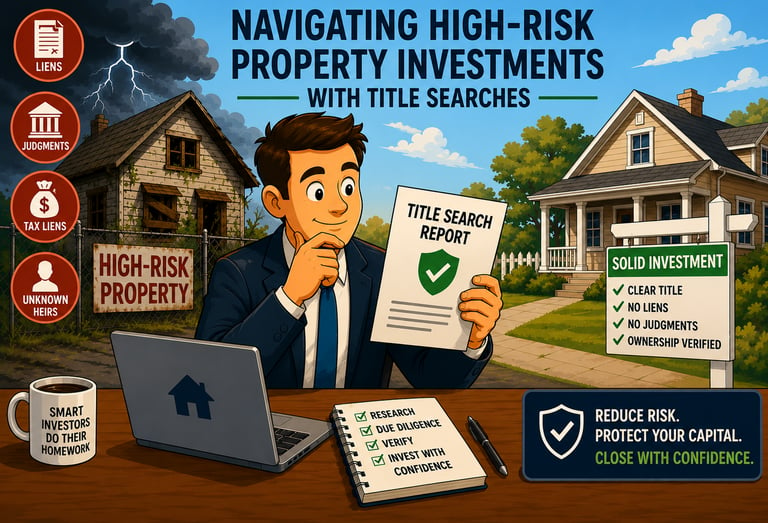
Investing in real estate can be a lucrative venture, but it comes with its fair share of risks, especially when dealing with high-risk properties. Whether you're purchasing from tax sales, land banks, or wholesalers, the potential for profit is significant—but so is the risk of encountering title issues. That's why conducting a thorough title search is essential. In this blog post, we'll explore the importance of title searches in mitigating risks and provide you with actionable steps to ensure your investments are sound.
Investing in High-Risk Properties
High-risk properties are those purchased through avenues such as county delinquent tax sales, land banks, wholesalers, HOA foreclosures, and over-the-counter lists. These properties often come at a lower initial cost but carry the potential for various hidden issues that could impede profitability. There is typically no guaranty ensuring a clear title when purchasing these properties which exposes investors to elevated risks.
Potential Profit Opportunities
Lower Purchase Price: High-risk properties are often sold at a fraction of their market value, offering significant upside potential.
Value-Add Opportunities: These properties often require renovations or improvements, providing opportunities for value addition and higher returns.
Growing Markets: High-risk properties are often located in up-and-coming areas, offering potential for significant appreciation.
Associated Risks
Unresolved Liens: Properties may come with unpaid taxes, utility bills, HOA dues, mortgages, etc...
Unclear Ownership: The chain of title may be incomplete or unclear, especially in foreclosures or tax sales.
Hidden Easements: There may be unrecorded easements or use restrictions that could impact future development or usage.
Not All High-Risk Properties Are the Same
The title risks you'll encounter vary significantly depending on how you're acquiring the property. Here's what to expect, and watch for, across the most common high-risk acquisition channels:
County Delinquent Tax Sales
These are among the highest-risk acquisitions for title issues. Even after a tax deed is issued, federal tax liens (IRS) and certain government liens may survive the sale. Municipal code violation liens, HOA assessments, and utility liens frequently survive as well, depending on your state. Prior ownership disputes and gaps in the chain of title are also common, especially on properties that have changed hands multiple times without being properly recorded.
What you typically find: Surviving federal liens, HOA liens, code violation liens, incomplete chains of title, unknown heirs.
Land Bank Properties
Land banks acquire properties through tax forfeiture and are generally a lower-risk channel, but they're not risk-free. Many land bank properties have long histories of neglect, meaning the chain of title can span decades of incomplete records. Environmental encumbrances and municipal easements are common. Some land bank deeds also carry deed restrictions limiting how the property can be used.
What you typically find: Deed restrictions, environmental liens, municipal easements, long and complex chains of title.
Wholesaler Assignments
Wholesale deals feel low-friction, but that's exactly why they're risky. Wholesalers often haven't done a title search before assigning the contract to you. You're buying based on what the wholesaler was told, not what the records actually show. Undisclosed liens, incorrect ownership assumptions, and unrecorded interests are all common.
What you typically find: Undisclosed liens, seller misrepresentation, unrecorded assignments, quitclaim deed chains.
HOA Foreclosures
HOA foreclosures are a specialized category. The HOA's lien priority varies by state, in some states it's "super-priority" (meaning it can wipe out a first mortgage), in others it's subordinate to the lender's interest. Purchasing at an HOA foreclosure sale doesn't necessarily eliminate the first mortgage. These properties also frequently have additional HOA assessments that accumulated post-foreclosure that become the new owner's responsibility.
What you typically find: First mortgage surviving the HOA foreclosure, accumulated assessments, other HOA violations, recorded restrictions.
Over-the-Counter (OTC) Lists
Properties on OTC lists didn't sell at the tax sale, often for a reason. They may have environmental contamination, structural condemnation orders, access issues (landlocked), or title problems so complex that experienced investors passed. These require the most thorough due diligence of any acquisition type.
What you typically find: Environmental issues, condemnation orders, access/easement problems, deeply flawed title chains.
Ready to protect your next deal?
Order your title search before you close, not after.
Order Now →
Matching Your Title Search to Your Investment Type
Current Owner Search
Covers the current owner's period of ownership. Ideal for identifying existing liens, encumbrances, and easements tied to the current deed. This is the right starting point for most tax sale purchases where you need a fast read on the property's current status.
2-Owner Title Search
Goes back one additional owner, typically covering 15–30 years of history depending on how long each owner held the property. Recommended when you're planning to hold or rent the property, or when the current owner acquired it through a non-traditional transfer (quitclaim deed, tax deed, estate transfer).
Full Title Search
A comprehensive search going back to the root of title, typically 40–60 years. This is what title insurance underwriters require before issuing a policy, and it's what you need when you're planning to resell with a clear title, refinance through a lender, or when the property has a complex or incomplete ownership history.
Not sure which applies to your deal? Contact us and we'll point you in the right direction before you order.
What Happens When Investors Skip the Title Search
The Real Cost of Skipping a Title Search
Title issues don't surface at closing, they surface six months later when you're trying to sell, refinance, or rent. By then, you're no longer dealing with a title problem. You're dealing with a legal problem, a financial problem, and often a project that's completely stalled.
Here's what that looks like in practice:
Scenario 1: The Surviving Lien
An investor purchases a property at a county tax sale in Georgia for $18,000. The tax deed appears clean. Six months later, after spending $40,000 on renovations, they list the property, only to discover a $22,000 IRS federal tax lien that survived the sale. Federal liens are not extinguished by state tax sales. The investor can't sell until the lien is resolved. Negotiating with the IRS takes four months and costs thousands in legal fees.
What a Full Title Search would have revealed: The IRS lien, recorded in the federal tax lien index, before a single dollar was spent on renovations.
Scenario 2: The HOA Assessment Trap
An investor purchases an HOA foreclosure property assuming the HOA's claim is settled. What they didn't know: the HOA had been accruing monthly assessments, late fees, and attorney fees for three years after the foreclosure judgment, and those post-judgment assessments become the new owner's liability the moment they take title. The bill: $8,400.
What a Current Owner Search would have revealed: The active HOA lien with current balance, allowing the investor to negotiate payoff before closing.
Scenario 3: The Wholesaler Chain Problem
An investor buys an assignment from a wholesaler. The wholesaler acquired the deal via a quitclaim deed from an estate, but one heir never signed. The property is now tied up in a quiet title action. The investor loses 14 months and $12,000 in carrying costs and legal fees waiting for the cloud on title to be cleared.
What a 2-Owner Title Search would have revealed: The quitclaim deed, the estate transfer, and the missing signature, before the contract was signed.
The math is simple. A title search costs a fraction of what it costs to untangle a title problem after you own the property. The question isn't whether you can afford a title search. It's whether you can afford to skip one.
Why a Current Owner Search is Essential
A Current Owner Search is crucial for identifying hidden liens and encumbrances, verifying ownership, and uncovering any easements or restrictions. Here's why it's indispensable for high-risk property investments:
Identify Hidden Liens and Encumbrances
High-risk properties are more likely to have unresolved liens, such as unpaid taxes, utility bills, or HOA dues. A Current Owner Search will reveal any such liens that could affect the property's value or marketability.
Verify Ownership and Chain of Title
In many high-risk acquisitions, the chain of title may be incomplete or unclear. A Current Owner Search helps confirm that the seller has a clear, legal right to transfer the property, preventing disputes over ownership after purchase.
Uncover Easements and Restrictions
Properties from delinquent tax sales or land banks may have hidden easements or use restrictions that could impede future development or usage. Understanding these encumbrances before purchase allows investors to make informed decisions and avoid costly surprises.
Title Risk Varies by State, Know Before You Buy
Title law, lien survival rules, and redemption rights are governed at the state level, and the differences are significant. What's true in Arkansas is not true in Georgia. What survives a tax sale in Indiana may not survive one in Florida.
We've built in-depth investing guides for each of the states we cover. If you're buying in any of these markets, start here before you bid:
🏛️ Arkansas Tax Sale Investing Guide, Arkansas uses a unique tax-sale process through the Commissioner of State Lands (COSL). Redemption periods, title challenges, and lien survival rules are distinct from most other states.
🌴 Florida Tax Deed Investing Guide, Florida's tax deed process is court-supervised and competitive. Understanding what survives (and what doesn't) is critical before bidding.
🍑 Georgia Tax Deed Investing Guide, Georgia uses a hybrid "tax deed" system with a 12-month right of redemption. Federal liens, HOA liens, and certain municipal assessments can survive the sale.
🌽 Indiana Tax Lien Investing Guide, Indiana operates a tax lien certificate system, not a deed system. The path to ownership is longer, and the title risks are different at every stage.
Each guide covers what survives the sale, redemption rules, due diligence checklists, and how to use title searches effectively in that specific state.
Don't Let a Title Issue Derail Your Deal
High-risk properties offer real opportunity, but only for investors who do their homework. A title search isn't a formality. It's the difference between a profitable flip and a legal nightmare that eats your margin and your time.
At Blazer Title Search, we specialize in the exact property types that carry the most title risk: tax sales, land banks, wholesaler deals, HOA foreclosures, and over-the-counter acquisitions. We'll tell you what's there, clearly, quickly, and affordably.