
Quitclaim Deeds: Guide for Real Estate Investors
Learn how real estate investors use quitclaim deeds, how to avoid property title issues, and why a title search protects your investments. .
REAL ESTATE INVESTING
Nick Thomas
4/6/20268 min read
Key Sections
As a real estate investor, you have likely heard the term "quitclaim deed" thrown around at local networking events or online forums. Some people mistakenly call it a "quick claim" deed, and while it does offer a fast way to transfer property, misunderstandings about how it works can cost you thousands of dollars.
Real estate investors use quitclaim deeds every single day to transfer property nationwide. If you ask a title company or an attorney, they might warn you to avoid transferring or purchasing real estate this way. They have a good reason for this warning. While quitclaim deeds offer a fast, easy, and inexpensive method to transfer real estate, they also open the door to serious property title issues for both buyers and sellers.
If you plan to use this document in your investing business, you need to understand the risks and how to protect yourself. This guide breaks down exactly what a quitclaim deed is, how it differs from other deeds, the potential traps you might face, and how a thorough title search from Blazer Title Search keeps your investments safe.
What is a Quitclaim Deed (QCD)?
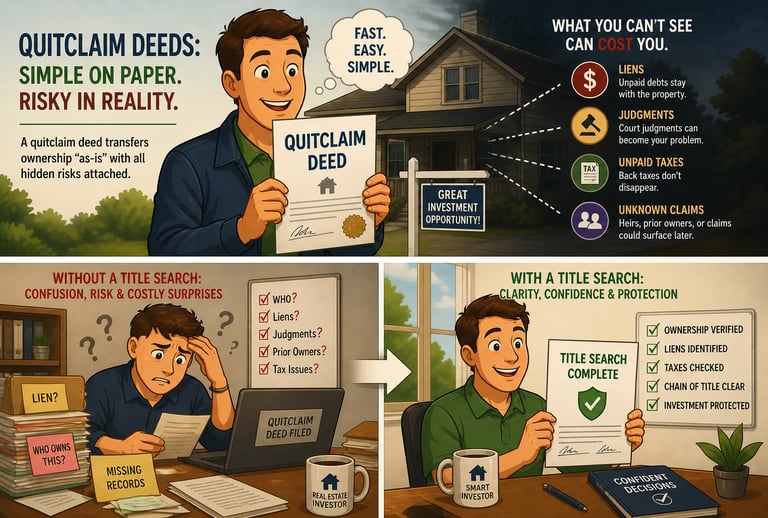
A quitclaim deed is a legal document that transfers ownership interest in a piece of real estate from one party to another. Crucially, it transfers that interest along with all liens, judgments, and encumbrances attached to the property.
When you receive a quitclaim deed, you become the grantee. As the grantee, you receive whatever interest the seller had in the property, but you also take full responsibility for all existing debts and legal claims against it.
You must understand that a deed is not the same thing as a title. A title represents the recorded history of ownership for a property. A quitclaim deed is simply one document found within that chain of title. The county records the chain of title, so any recorded quitclaim deed becomes part of that official history. If a quitclaim deed serves as the most recent recorded document, it defines the current ownership of the property.
The Benefits of Using Quitclaim Deeds
Despite the warnings from legal professionals, real estate investors frequently use quitclaim deeds because they offer several distinct advantages:
Speed and Efficiency: A quitclaim deed allows investors to offload real estate quickly.
Low Risk for Sellers: Because this deed offers no warranty or guarantee regarding the condition of the title, the seller walks away with little to no lingering risk.
Cost-Effective: Quitclaim deeds feature straightforward language and cost very little to draft. Either the buyer or the seller can record the document at the county clerk's office.
Direct Transactions: Most investor-related quitclaim transactions occur directly between the buyer and seller. This direct transfer helps parties bypass expensive attorney or title company fees.
Common Property Title Issues with Quitclaim Deeds
Quitclaim deeds offer a fast and cheap way to transfer real estate, but they come with a massive caveat: they offer zero warranties to the buyer. When you accept a quitclaim deed, you assume all liabilities attached to the property.
This lack of warranty does not make all quitclaim transfers bad. However, buyers must exercise extreme caution. If a seller insists on only using a quitclaim deed, treat that as a red flag. It often signals underlying property title issues that could burn an unsuspecting buyer.
Common issues buyers face when accepting a quitclaim deed include:
Unpaid municipal liens
Active condemnation notices
Unreleased mortgages from previous owners
Significant breaks in the chain of title
Sellers face risks as well. If you fail to fill out the deed correctly, the county might reject and refuse to record it. Furthermore, if you send a signed quitclaim deed to a buyer and they forget or refuse to record it, you technically still own the property. This means you remain entirely responsible for the property taxes, code violations, and other liabilities.
Quitclaim Deed vs. Warranty Deed
Both quitclaim and warranty deeds define ownership interest in a property's chain of title. Both are recorded documents. However, they deliver entirely different levels of protection.
A warranty deed conveys property with a strict guarantee that the title remains free and clear of all liens and encumbrances. The new owner holds an unchallenged senior position in the chain of title. Title insurance policies almost always back up warranty deeds. While you can technically convey a property via a warranty deed without title insurance, the seller becomes financially responsible if any claims arise later.
A quitclaim deed carries absolutely no warranty or guarantee regarding the condition of the title. You get exactly what the seller owns, problems and all.
Quitclaim Deed vs. Tax Deed
Although quitclaim deeds and tax deeds both transfer property without warranties, they function very differently.
Only a county government can issue a tax deed. They use this document to transfer property to a buyer in exchange for paying off delinquent property taxes. In many areas, a tax deed wipes out mortgages, mechanic's liens, and other encumbrances. However, the county does not guarantee that these encumbrances are permanently extinguished, which creates a cloud on the title.
Because tax deeds wipe out liens but leave behind a clouded title, quitclaim deeds become very popular among tax deed investors. Investors often buy these properties for just a few hundred dollars. They do not want to spend the time or money required to clear the title cloud through a quiet title action. Instead, they sell the property quickly and convey the title to the new buyer using a quitclaim deed. They wash their hands of the property and its liabilities.
For the new buyer, this presents a double-edged sword. You can purchase these properties for well under market value. However, you must take on the difficult work of clearing the clouded title before you can renovate, refinance, or sell the property at retail value.
How to Safely Buy a Quitclaim Deed Property
If you want to buy a property from a seller who only offers a quitclaim deed, you must perform rigorous due diligence. Buying real estate this way can be highly profitable, but jumping in blind will lead to disaster.
At the bare minimum, you must order a professional title search. Blazer Title Search helps real estate investors uncover hidden traps before they buy. A Current Owner Search (also known as an Owners & Encumbrances report) or a Two-Owner Search provides enough historical data to reveal major property title issues.
Keep in mind that a title search only shows what exists in the public record. Many municipalities do not record unrecorded liens, open permits, and code enforcement violations in the county chain of title. Even though they do not appear on a standard county search, the local government can still enforce them. Be sure to contact the trash, water, sewer, and code enforcement departments of the municipality for payoffs.
Always take the following steps when buying a property via quitclaim deed:
Order a comprehensive title search from Blazer Title Search.
Call the local municipal departments (water, sewer, code enforcement) to check for unrecorded balances.
Verify the seller actually has the legal right to sell the property.
What happens if the city has mowed the lawn for three years and attached a $10,000 lien to the house? These issues will not stop the county from recording your quitclaim deed, but the moment that deed records, that $10,000 debt becomes your problem.
How to File a Quitclaim Deed
For the best and safest results, real estate investors should complete a quitclaim deed transaction using a limited closing with a title company or attorney. This adds a slight cost, but it ensures you execute the transaction perfectly.
If you decide to proceed without professional guidance, follow these essential steps:
1. Deed Preparation
The seller typically takes responsibility for preparing the document. You can find free templates online or purchase state-specific forms from legal document websites for around $50.
2. Document Review
Once the seller prepares the document, the buyer must review it for accuracy.
Pro Tip: If the seller operates as an LLC, request their Articles of Organization, Certificate of Good Standing, and Operating Agreement. This proves the entity has the right to sell the asset and that the person signing the deed holds the legal authority to do so. If the seller is an individual, request a clear copy of their driver's license.
3. Transfer of Funds
Handling money outside of a title company creates friction. Sellers hesitate to record the deed before receiving the cash. Buyers refuse to send cash until the deed records. Setting up a small escrow arrangement offers the safest path forward.
4. Execution and Recording
Once you agree on the transfer of funds, the seller signs the deed in front of a notary public. The buyer or seller then takes the original notarized document to the county clerk's office to record it. The quitclaim deed then officially enters the public chain of title.
Pro Tip: Many real estate investors list $0 or $10 as the consideration (purchase price) on the deed to minimize transfer taxes at the time of the sale. Check your local laws, as this practice remains legal and standard in many jurisdictions.
How Much Does a Quitclaim Deed Cost?
Using a quitclaim deed provides a cheaper and faster way to close a real estate deal. Even if you route the transaction through a title company or attorney, you will only spend a few hundred dollars. This small fee guarantees the county records your deed correctly and keeps your funds safe in an escrow account.
Here is a breakdown of the standard fees you can expect:
Current Owner Title Search: $75 average
Recording Fee: Varies widely by state, county, and page count
Transfer Tax: Varies by state, county, and the consideration listed on the deed
Escrow Fee: $250 average
Deed Preparation: $150 average
Where Can Real Estate Investors Use Quitclaim Deeds?
Most states across the country recognize quitclaim deeds. They see heavy use in states with massive real estate investing activity, including Florida, Michigan, Pennsylvania, and Georgia.
However, local nuances exist. In Texas, many title insurance underwriters refuse to recognize a quitclaim deed as a valid conveyance of title. Instead, Texas investors use a "Deed Without Warranty," which functions almost exactly like a quitclaim deed but satisfies local underwriting requirements.
The Threat of Quitclaim Deed Fraud
With counties moving their recording functions online and DIY real estate investing growing in popularity, deed fraud has skyrocketed. Fraudsters overwhelmingly prefer quitclaim deeds to execute their scams.
A fraudster will typically forge a notary stamp and convey a vacant or distressed property to themselves via a fake quitclaim deed. They quickly turn around and sell the property to an unsuspecting cash buyer, insisting on using a quitclaim deed to close the deal. The fraudster pushes for this to avoid using an attorney or title company, which would easily catch the scam.
Because deed fraud runs rampant, title professionals instantly flag transactions that feature multiple consecutive arm's length quitclaim deeds. If you notice a string of recent quitclaim deeds on your title search, sound the alarm, ask tough questions, and bring in a professional.
Are Quitclaim Deeds Safe?
A seller conveying a property via a quitclaim deed is not inherently dangerous. Many traditional title professionals will loudly state that the industry never intended for investors to use quitclaim deeds this way. However, no law prevents real estate investors from using them to run their businesses efficiently.
The safety of a quitclaim deed depends entirely on the knowledge and preparation of the parties involved. Both the buyer and the seller must understand the pitfalls. Buyers must take extra precautions by examining a comprehensive title search before wiring any funds.
Blazer Title Search specializes in providing real estate investors with the exact title searches needed to navigate these transactions safely. With nationwide coverage, Blazer Title Search delivers Current Owner and Owners & Encumbrance reports in just a few days, giving you the clarity you need to invest with confidence.
Ready to invest with confidence?
Before you buy a quitclaim deed property, protect yourself with a professional title search. Blazer Title Search delivers fast, accurate Current Owner and Two-Owner Search reports nationwide, so you know exactly what you're buying before you wire a dollar.
Order Your Title Search Today →
The information provided in this article is for general informational and educational purposes only and should not be construed as legal, financial, or investment advice. Blazer Title Search is not a law firm and does not provide legal advice or representation.
While we strive to provide accurate and up-to-date information, real estate laws, title practices, and regulations vary by state and can change over time. You should consult with a qualified real estate attorney, title professional, or licensed advisor before making any decisions related to property transactions.
Blazer Title Search shall not be held liable for any losses, damages, or liabilities arising from the use of, or reliance on, the information contained herein or from any real estate investment decisions made by readers. All investment decisions are made at your own risk