
What is a Title Search and Why Every Deal Needs One
Before you close on a property, there’s one step that can save you from inheriting costly liens, ownership disputes, or hidden legal problems: the title search. This guide breaks down exactly what a title search is, what it uncovers, and why smart buyers and investors never skip it.
REAL ESTATE TITLE SEARCH
Nick Thomas
5/14/20268 min read
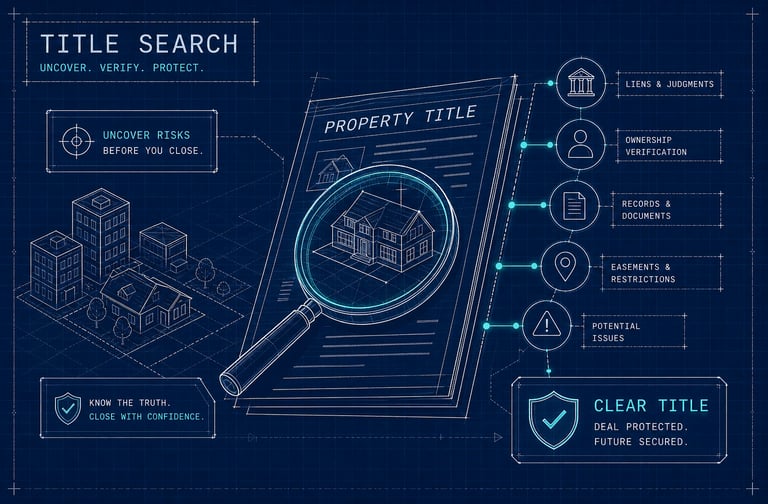
What is title search, and why does it matter before you close? Many buyers sign off on the biggest purchase of their lives without fully understanding what they're getting. They see the property, negotiate the price, and assume the paperwork takes care of everything else. That assumption is where deals go wrong. A property title search is the step that changes it. It reviews who legally owns the property, what debts are attached to it, and whether the ownership history is clean enough to transfer, though it's worth noting that even a thorough search examines only recorded public records and cannot catch every unrecorded claim or indexing error. That's a separate problem, and it's why title insurance exists alongside the search.
This article covers what a title search actually is, how it works, what it finds, who does it, and how it differs from title insurance. Whether you're a first-time homebuyer, a real estate investor, or an attorney handling a closing, the same core principle applies: ordering a title search before closing is standard industry practice and strongly recommended.
What is a title search, definition and scope
The chain of title: what it means and why it matters
A title search is a review of a property's public record history going back far enough to confirm the current seller has the legal right to sell. The backbone of that review is the chain of title: the documented trail of every ownership transfer the property has gone through, from the earliest recorded deed to the present owner. Think of it as a Carfax report for real estate. If there's a gap in that chain, the deal has a problem.
A clean chain means every transfer was properly documented, executed, and recorded. A broken chain means at some point along the way, an ownership transfer wasn't handled correctly. That gap can become a serious complication the moment you close, potentially requiring litigation, a seller cure, or a title insurance claim to resolve.
What is a title search looking for
The examination isn't just about who owns the property today. It's about whether any prior owner left behind unresolved debts, disputed claims, or incomplete transfers. A full deed search goes back 30 to 60 years depending on the transaction type and state requirements. The goal is to build a clear, continuous legal history that leaves no ambiguity about ownership or encumbrances before money changes hands.
What a title search examines: the records behind the report
Public records pulled during a search
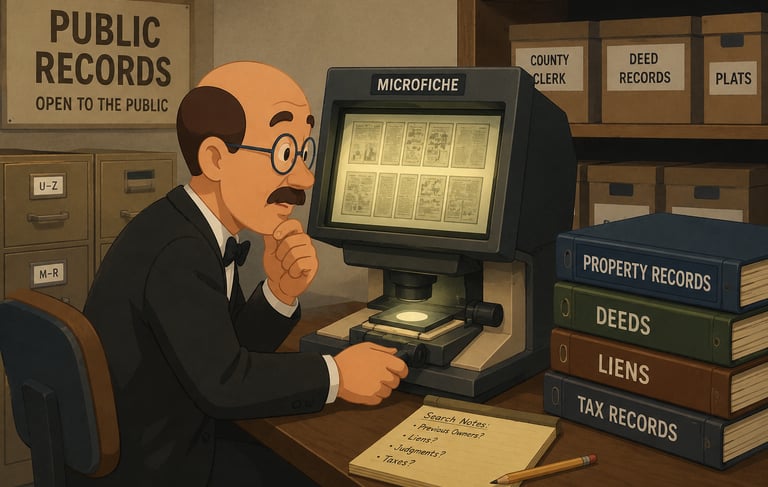
A title examiner pulls records from multiple sources: the county recorder's office, tax assessor records, probate court filings, federal bankruptcy databases, and lien indexes. The combination paints a complete picture of the property's legal status. Different states and counties store records differently. Some offer statewide databases; others keep everything at the city or county level. That variation is exactly why local expertise matters and why a professional search is worth the cost.
Ownership history, liens, and unpaid taxes
These are the core findings in any title report. Ownership history confirms whether the seller's name matches the recorded deeds and whether every prior transfer was properly documented. Liens are legal claims attached to the property for unpaid debts, and they come in several forms:
Mortgage liens from outstanding loans
Tax liens for unpaid property taxes, which stay with the property not the person
Mechanic's liens filed by contractors who weren't paid for work done
Judgment liens from court-ordered debts tied to a prior owner
HOA assessment liens for unpaid association fees
Every one of these can survive a property sale and transfer directly to the new owner if not cleared before closing. If this occurs, oftern times the only remedy is an action to quiet title.
Easements, restrictions, and other encumbrances
A search also surfaces rights other parties hold over the property. Utility easements allow access to run lines across the land. Access rights give neighbors the legal ability to cross part of your parcel. Deed restrictions limit how the land can be used, and some run with the property in perpetuity. These aren't always defects that kill a deal, but you need to know about them before you sign anything. Examples of common title defects are municipal liens, code enforcement violations, open mortgages and mechanics liens. The most practical steps to resolve them, is for a title company to order a payoff and then record a release.
Common problems a title search uncovers
Liens are the most common issue found
Liens top nearly every list of title defects across the industry. They're the single most frequent problem uncovered in residential searches, and they're especially common on distressed properties. The critical thing to understand is that unknown liens don't disappear at closing. In many cases, the new owner inherits them. An undiscovered mechanic's lien from a contractor who wasn't paid before the previous owner sold can land directly on your ledger the day you take title. That reality is one reason many experts stress the importance of ordering a title search early in the process.
Forgeries, errors, and ownership gaps
Beyond liens, forgeries and fraud represent a significant share of title insurance claim payouts by value, according to industry data from title insurers and claims analyses. Forged signatures on deeds are harder to catch than most buyers assume, especially when the fraud occurred years or decades before the current transaction. Clerical errors in recorded documents, misspelled names, incorrect legal descriptions, are common enough that they show up in a meaningful share of searches. Gaps in the chain of title, where a prior transfer was never properly recorded, are another frequent finding. According to industry estimates, roughly one in three title examinations turns up issues requiring some form of corrective action before a deal can close. That's not a rare edge case. That's the reason the search exists. If you want step-oriented instructions for performing a property title search yourself or understanding the examiner's work, review this article on how to perform a property title search.
Who performs a title search and what you receive
Title companies, abstractors, and real estate attorneys
For most residential transactions in the United States, a licensed title company or abstractor handles the search. In around a dozen to seventeen states, a real estate attorney is required to either conduct or oversee the title examination as part of the closing process, though the specific requirements vary by state. States like Georgia, Louisiana, South Carolina, and North Carolina have strict requirements that treat title examination as the practice of law. Title searchers and abstractors provide the search, the attorney has the final say on examination and insurability. Outside those states, title companies and abstractors handle the bulk of residential searches independently.
Specialized providers for investors and legal professionals
Not every transaction needs the same type of search, and not every provider is built to serve every client. A homebuyer purchasing a primary residence typically needs a full 30- to 60-year search. A real estate investor bidding at a tax deed auction may only need an Owners and Encumbrance (O&E) report to surface active liens and confirm current ownership. A pre-foreclosure attorney needs a 2-owner search to support legal noticing.
Not every transaction needs the same type of search, and not every provider is built to serve every client. A homebuyer purchasing a primary residence typically needs a full 30- to 60-year search. A real estate investor bidding at a tax deed auction may only need an Owners and Encumbrance (O&E) report to surface active liens and confirm current ownership. A pre-foreclosure attorney needs a 2-owner search to support legal noticing.
Blazer Title Search is built specifically for this kind of professional, investor-focused work. It offers investor-specific search types and includes supporting documents with reports so clients can verify findings directly rather than relying on a summary alone. For current turnaround times, rush availability, and product details, check Blazer's current service listings directly.
What a title report actually looks like
The output of a title search is a written report, sometimes called a preliminary title report or title commitment, that lists the confirmed legal owner, any open liens or encumbrances, title defects requiring resolution, and recommendations for what needs to be cleared before closing. Some specialized providers include the underlying source documents alongside the findings. That matters because it gives the client a direct line back to the recorded records rather than a summary they have to take on faith.
Title search vs. title insurance: they're not the same thing
The search finds problems; insurance covers what the search missed
A lot of buyers confuse these two, and the confusion is costly. A title search is a pre-closing investigation, a snapshot of the recorded public record at that specific moment in time. Title insurance is what protects you after closing from defects that weren't discoverable during the search: fraud committed before your purchase, forged documents, unknown heirs who surface years later, unrecorded claims, or indexing errors at the recorder's office. It is the title insurance underwriters responsibility to identify these issues and resolve them before you close. The search minimizes known risk. Insurance covers unknown risk. You need both.
What an owner's title insurance policy actually covers
There are two policy types. The lender's policy protects the mortgage lender's interest, is required by most lenders, and is paid by the buyer at closing. The owner's policy protects the buyer directly. It's optional in most states but strongly recommended. An owner's policy covers legal defense costs and financial loss up to the purchase price if a valid title claim surfaces after closing. It's a one-time premium with no renewals. Standard exclusions apply: zoning issues, visible easements, and defects the buyer already knew about before closing are not covered.
Cost, timeline, and what to do next
What a title search typically costs and how long it takes
Residential title searches run $42 to $250 in most markets. Complex properties, older records, or high-cost areas can push costs toward $300 to $500. The standard turnaround for a residential search is typically 2 to 5 business days, though this varies by county and transaction complexity. For time-sensitive deals, rush service is available from most professional providers and can cut that window significantly. Commercial searches cost more and take longer.
Who pays, and when you should order one
In most transactions, the title search cost is bundled into closing costs. Whether the buyer or seller pays depends on local custom. The timing is what matters most: the search needs to happen before you commit to a deal, not after. For investors buying at auction, pre-foreclosure, or off-market, ordering a search before finalizing any purchase is standard practice. A $75 search that surfaces a $10,000 lien or an ownership dispute is the best money you'll spend in any transaction. The alternative is closing on a problem you now own.
The bottom line: what is title search really protecting you from
A title search is not a formality. It's the step that tells you what you're actually buying. The chain of title, the lien examination, the full public record review, all of it exists to answer one question before you close: is this property clean enough to buy? Skipping it doesn't save time. It defers risk until after the deal closes, when it costs far more to resolve.
The main takeaways: a title search reviews ownership history, surfaces liens and unpaid taxes, catches errors and fraud in public records, and gives you a clear picture of what you're taking on. Title insurance then covers what the search couldn't find. Both have a role, and neither replaces the other.
If you're working on an investment deal and need an investor-focused title examination with supporting documents included, Blazer Title Search is built for exactly that. Current owner searches, O&E reports, 2-owner pre-foreclosure reports, and full title searches are all available with state- and county-specific pricing through their online selection tool. Order before you close, not after you have a problem. For additional reading on investor-friendly title search options, see this overview of Georgia Redeemable Tax Deed Sales or this Florida Tax Deed Sales Guide and how title searches are used.
Have Questions?
Complete the form to hear from one of our title professionals