
Title Search Report: How to Read & Spot Red Flags Guide
Learn how to read a title search report, spot red flags like liens, easements, and vesting issues, and take practical steps to protect your real estate deal.
REAL ESTATE TITLE SEARCH
Nick Thomas
7/17/20269 min read
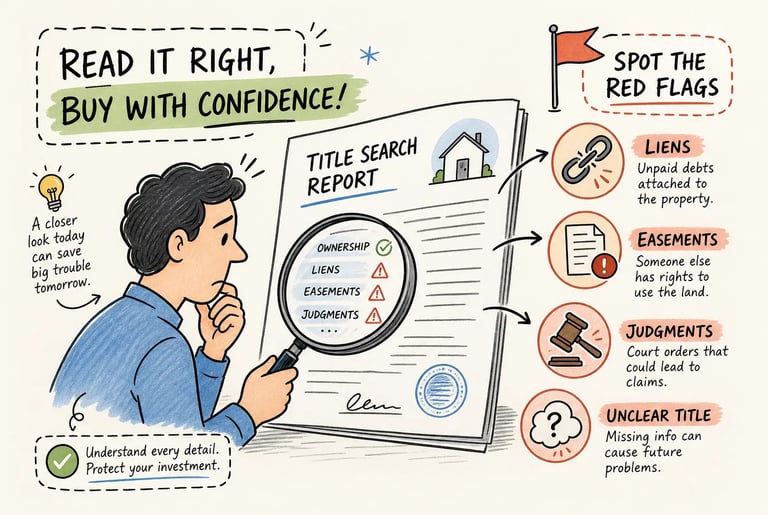
If you've ever asked yourself, "how do I read a title search report as a real estate investor?", start here. The title report is where deals quietly fall apart: unknown tax liens, unreleased mortgages, easements that gut your renovation plans, and judgment liens that survive the sale. Most investors underwrite the numbers long before they look at the title report. That's backwards.
Reading a title search report as an investor is not complicated, but it requires knowing what you're looking at and what order to look in. The report follows a predictable structure, and once you understand that structure, the red flags become obvious. At Blazer Title Search, every report is organized by section and backed by supporting documents so you're not guessing at what a recorded instrument actually means. That format is exactly what this article walks you through: the sections, the language, the red flags, and what to do when you find one.
How Do I Read a Title Search Report as a Real Estate Investor?
A title report is a snapshot of public record as of a specific date. It tells you who owns the property, how they hold it, what liens and encumbrances are recorded against it, and what conditions must be met before a title insurance company will issue a policy. It is not a guarantee of clear title. It is a conditional offer to insure, based on what public records show up to a specific point in time.
The name changes depending on where you're investing. California calls it a Preliminary Title Report, often shortened to "prelim." Florida and Texas call it a Title Commitment. The content is similar across all three, but the legal weight differs. In California, the prelim is an offer with explicitly limited liability. In Florida and Texas, the commitment is a binding contract obligating the insurer to issue a policy once requirements are met. Neither document is a final insurance policy, and neither covers anything recorded after its effective date.
That effective date deserves more attention than most investors give it. It is the cutoff for the public record search. Anything recorded after that date does not appear in the report. For distressed or off-market properties with a long due diligence period, a lien filed between the effective date and the closing date can attach to the deal and won't be caught unless you order a bring-down search closer to closing..
Schedule A Decoded: Ownership, Vesting, and Legal Description
Schedule A is where you start reading a title search report as an investor. It establishes who owns the property, how they hold title, and what property you're actually looking at. Every other section in the report builds on what Schedule A establishes, so a problem here touches everything downstream.
Vesting tells you the exact name on title and the form of ownership: sole owner, joint tenants, LLC, living trust, and so on. A mismatch between the vesting on the report and the name on your purchase agreement is a red flag that must be resolved before closing. For distressed properties, check whether the entity on title is still active. A dissolved LLC or expired trust creates a chain of title problem that requires legal action to unwind.
The legal description is the formal, recorded boundary description used in all filings. It controls over the street address. Lot and block, metes and bounds, and government survey descriptions are the most common formats. Confirm the legal description on the report matches the deed exactly. Any discrepancy points to a recording error that must be corrected before the title company will insure.
Schedule A also identifies the proposed insured and the policy amount. If you're taking title in an LLC, verify the entity name is correct here. A title insurance policy won't cover a party not listed on it, and fixing that error after closing is far more difficult than catching it before.
Schedule B Decoded: Requirements, Exceptions, and What They Mean for Your Deal
Schedule B splits into two parts that work in opposite directions. Part I tells you what has to happen before the title company will insure. Part II tells you what won't be covered after closing. Both require a careful read.
Schedule B-I: Requirements
Schedule B-I is the title company's to-do list. It lists conditions that must be met before the policy issues: payoff of existing mortgages, clearance of judgment liens, payment of delinquent taxes, recording of a new deed, and submission of curative documents like trust certifications or entity authorizations. Every item in B-I is a potential closing delay. Review this section immediately after receiving the report and flag anything that requires negotiation with the seller or additional lead time to resolve.
Schedule B-II: Exceptions
Schedule B-II is where the permanent exceptions live. These are the items the insurance policy will explicitly not cover unless they're negotiated out or covered by an endorsement. Common exceptions include utility easements, CC&Rs, HOA restrictions, mineral rights reservations, current-year taxes, and unrecorded rights of parties in possession. Not every exception is dangerous, but every exception needs to be read and understood before you commit to the deal.
Some B-II exceptions are insurable with an endorsement if the title company investigates and clears them. Unrecorded easements, boundary encroachments, and mechanic's liens sometimes fall into this category. Others are almost never removed: future tax assessments, mineral rights reservations, governmental takings, zoning ordinances, and CC&R restrictions are fixed parts of the title picture. Ask the title company which exceptions on your specific report can be negotiated and which are permanent.
Common Red Flags: Liens and Encumbrances That Can Kill a Deal
A clean Schedule A means nothing if Schedule B reveals a federal tax lien or an unreleased mortgage from a decade ago. Tax liens filed by the IRS or state revenue agencies attach to all property owned by the debtor and carry priority over most other claims. They must be resolved, not worked around. Judgment liens from lawsuits attach to real property in the county where they're recorded and survive a sale if they're not cleared. Both can be paid from sale proceeds at closing, but you need to know they exist before you agree to a purchase price.
Unreleased mortgages are common in title reports on distressed properties, and they don't always mean the debt is still owed. Sometimes the lender simply failed to file a satisfaction after the loan was paid off. Either way, an unreleased mortgage requires a recorded release document before or at closing, and tracking one down takes time. In Texas, the same lien appears as a Deed of Trust rather than a mortgage: same risk, different label.
HOA liens arise from unpaid dues and assessments. Some states allow HOAs to foreclose independently on delinquent properties, which makes these more than a nuisance. Mechanic's liens are filed by unpaid contractors and are especially common on recently renovated or newly constructed properties. Both lien types are typically junior in priority, but they can still complicate a title transfer. The report should show whether a release has been filed; if it hasn't, the debt needs to be settled before closing.
Federal and state tax liens: Highest priority, must be paid in full or subordinated before closing
Judgment liens: Filed from court rulings, attach to all real property in the county of record
Unreleased mortgages or deeds of trust: Require a recorded satisfaction or release document
HOA liens: Verify payoff amounts and whether a release has been recorded
Mechanic's liens: Especially common on recently improved properties; require a lien waiver or release from the contractor
How Title Reports Read Differently by State
Investing across multiple states means reading title reports in different formats, with different section names, and flagging different risk areas. What appears as a standard disclosure in one state may not surface at all in another until you specifically ask for it.
California's Preliminary Title Report follows CLTA-standardized Schedule A and B formatting. Mechanic's liens are explicitly disclosed as a standard section because California law gives contractors broad filing rights. Property tax status is detailed and appears prominently. Investors buying in California should scrutinize Schedule B-II for easements, CC&Rs, and unreleased deeds of trust, and treat any mechanic's lien finding as time-sensitive given how aggressively California contractors can enforce them.
Florida's Title Commitment uses section headers labeled "Requirements" and "Exceptions" rather than numbered schedules. It places greater emphasis on unrecorded liens, water rights, and survey exceptions where no survey was provided. Investors buying coastal or wetland-adjacent properties in Florida should specifically look for water rights disclosures and easement by prescription findings, which sometimes don't surface until a survey is ordered.
Texas commitments include a dedicated Mineral Rights section that is often a major factor for rural or energy-adjacent properties. Texas also documents liens under "Deed of Trust" rather than mortgage, which changes the language throughout the report. Survey exceptions are a prominent section in Texas commitments, and investors should verify whether a survey was conducted before closing. Purchasing surface rights without understanding the mineral rights picture creates long-term access and liability issues that are difficult to unwind after the fact.
What to Do After You Find a Red Flag
Finding a problem in the title report is not the end of the deal. It's the beginning of a decision. Investors who know their options close more deals and lose less money than those who treat every red flag as a dealbreaker.
Liens with a known dollar amount can often be paid from sale proceeds at closing. Tax liens, HOA arrears, and judgment liens fall into this category. Factor these costs into your offer before you sign, not after. Mechanic's liens with disputed validity can be challenged through a quiet title action, which adds time but can eliminate the encumbrance entirely. Some B-II exceptions, like unrecorded easements or boundary issues, can be covered with a title insurance endorsement if the insurer is willing to investigate and clear them. Ask directly; the answer is often yes if the underlying issue is minor.
Some red flags are harder to resolve. Easements that run directly through a planned building footprint, CC&Rs that prohibit your intended use, or mineral rights severances that expose you to surface access claims are often not curable. Federal tax liens with no clear resolution path and sellers who won't cooperate with payoff negotiations are a hard stop for most investors. A report that lists a dozen B-II exceptions without supporting documentation gives you no basis to evaluate severity, that alone is a reason to demand clarification before proceeding.
The difference between a confusing title report and a useful one is documentation. Supporting instruments, recorded documents attached to findings, and findings organized by priority turn a list of references into an actionable picture. Blazer Title Search structures every investor report this way because you can't make a sound decision based on vague references to recorded instruments you've never seen. A well-formatted report cuts the time you spend deciphering and increases the time you spend deciding, which matters when you're running due diligence across multiple deals and jurisdictions simultaneously.
Read the Report Before You Close, Every Time
Once you know how to read a title search report as a real estate investor, the structure stops feeling dense and starts feeling useful. Schedule A tells you who owns the property and how. Schedule B-I tells you what has to be cleared before closing. Schedule B-II tells you what won't be insured. Everything worth worrying about lives in one of those three places.
The red flags are almost always predictable: tax liens, unreleased mortgages, judgment liens, HOA arrears, easements that interfere with your plans, and state-specific exceptions that catch out-of-market investors off guard. None of these are surprising once you know where to look and what each finding actually means.
What changes the outcome is knowing what to do once you find an issue. Clear it, negotiate it, insure around it, or walk away. That decision gets easier the more clearly the report presents the findings. The cost of confusion is higher than the cost of getting it right the first time.
Frequently Asked Questions
How do I read a title search report as a real estate investor?
Start with Schedule A to confirm ownership, vesting, and the legal description. Then move to Schedule B-I to identify what must be resolved before closing, and Schedule B-II to understand what the policy won't cover. Flag anything you don't recognize and request the supporting recorded documents before making a final decision.
What is Schedule B in a title report?
Schedule B is split into two parts. Schedule B-I lists requirements, conditions that must be met before a title insurance policy will issue. Schedule B-II lists exceptions, items that won't be covered by the policy after closing. Both sections require a careful read before you commit to a deal.
What's the difference between a Preliminary Title Report and a Title Commitment?
The terms describe the same basic document by different names. California uses "Preliminary Title Report" (or "prelim"), while Florida and Texas use "Title Commitment." The legal obligations differ: the California prelim carries limited liability, while the commitment in Florida and Texas is a binding contract to issue a policy once requirements are met.
Do I need a bring-down search before closing?
If your due diligence period is long, or the property is distressed or off-market, yes. The title report only covers public records up to its effective date. A lien filed after that date won't appear in the original report. A bring-down search run close to closing catches anything recorded in the gap.