
Real Estate Title Search: A Complete Guide for Investors
A real estate title search is one of the most important due diligence steps an investor can take before buying a property. This guide explains what a title search includes, how to spot common red flags like liens, ownership gaps, probate issues, and easements, and when it makes sense to bring in a professional title search company like Blazer Title Search.
REAL ESTATE TITLE SEARCH
Nick Thomas
6/13/20269 min read
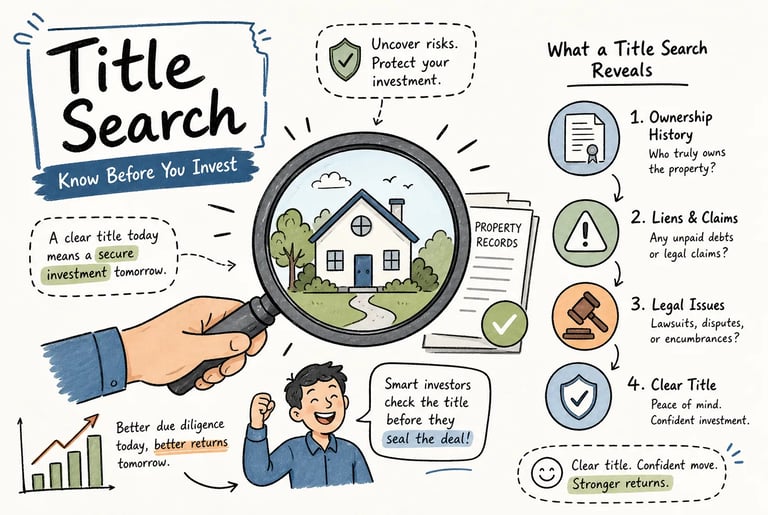
A real estate title search can prevent costly surprises, and the alternative is painfully clear. An investor closes on a distressed property, celebrates the deal, then gets a letter three weeks later from a contractor who was never paid by the owner two transfers back. The lien is real, it attached to the property, and now it's the new owner's problem. Title issues like this surface regularly in distressed transactions, and they're almost always the result of a skipped or rushed title search.
A real estate title search is a review of public property records to confirm legal ownership, surface existing liens, and identify any claims that could affect a buyer's rights to the property. It's not a formality you complete because your closing agent asks for it. It's the due diligence backbone of any property transaction, and skipping it is one of the more expensive mistakes in this business. Investors need faster, more targeted searches than a general closing agent typically provides, which is exactly the gap that specialized title search services are built to fill.
This guide covers what a title search actually includes, how to run a basic one using public records, how to read what you find, and when to bring in a professional. By the end, you'll know which search type your deal requires and what the results are telling you.
What a real estate title search actually covers
A title search isn't a single document you pull from a database. It's an investigative process that layers multiple types of public records together to build a complete picture of a property's legal history. Understanding the components helps you know what you're looking for and what can go wrong.
The public records involved
The core records in any title search are deeds, mortgages, tax records, judgment liens, mechanic's liens, and easements. These are filed at the county level, typically with the county recorder, clerk of courts, or register of deeds, depending on the state. Every recorded instrument creates an entry in the public record, and that entry either supports or complicates the ownership claim on the property.
County tax records run parallel to land records and are equally important. An investor needs to confirm not just who holds the deed but whether property taxes are current, because tax delinquency can create its own lien priority problem.
Title abstract vs. title report: What's the difference
A title abstract is a chronological summary of every recorded instrument in a property's history, assembled from the earliest entry to the most recent. A title report, sometimes called a preliminary report or O&E report, is a current-status snapshot showing the existing owner, open liens, and any recorded exceptions. The full title search is the underlying research process that produces either output. Tax deed investors typically need a current-owner O&E report; purchase transactions at closing usually require the full historical search.
For a general primer on what a title search includes and how reports are presented, resources from major lenders can be helpful to understand core terms and expectations. For a straightforward overview of the title search process, see this explanation on Rocket Mortgage's site: what a title search is.
How chain of title is established
The chain of title is the unbroken sequence of ownership transfers from the original grant to the current owner. Each deed in the chain must connect to the next, with no gaps, missing conveyances, or unrecorded transfers. When that sequence breaks, it creates a title defect. Defects don't disappear just because a property changes hands, they follow the property and become the new owner's legal burden unless they're resolved before closing.
Why skipping a property title search puts your investment at risk
The risk here isn't theoretical. Investors lose real money when title issues surface after they've already closed. These problems fall into predictable categories, and knowing them makes you a sharper buyer on distressed and off-market deals.
Hidden liens and unpaid judgments
The most common financial threats in a title search are mechanic's liens from unpaid contractors, IRS federal tax liens, HOA liens, and court judgment liens. These liens attach to the property itself, not just to the former owner personally. That means they survive an ownership transfer unless they're resolved before the deed changes hands. The new buyer inherits them, full stop. For a concise definition of what a lien is and how it functions against property, see Investopedia's overview: lien explained.
Ownership gaps, probate issues, and missing heirs
Distressed and off-market properties, the exact deals investors target most aggressively, are also the most likely to have informal ownership transfers in their history. When a prior owner died and the estate was never properly probated, or when heirs existed but never formally signed off on the transfer, competing ownership claims remain alive. These situations are especially common in properties that have sat vacant or changed hands through family arrangements rather than formal sales.
What a clouded title actually costs you
A clouded title has direct financial consequences: you can't get title insurance, deals collapse at closing, and if you've already closed, you may be looking at a quiet title action that can run thousands of dollars in legal fees and months of delay. A lis pendens filing against a property you just purchased means litigation is already in play on the ownership. These are not recoverable situations without significant cost and time, both of which eat directly into your return on the deal.
How to run a basic real estate title search using public records
A DIY title search has real limits, but it's worth knowing how the process works. A quick preliminary check can tell you whether a deal has obvious problems before you spend money on a professional report, and it makes you a more informed buyer when you do review professional results.
Finding the right county records portal
Start by identifying the county where the property is located, then find that county's official recorder, clerk of courts, or register of deeds website. Access varies significantly: some counties provide free online image access with full document viewing; others route you through statewide portals or third-party systems; and some older counties still require in-person visits for records that haven't been digitized. The county property appraiser or tax assessor site is a useful parallel check for ownership and tax status, and most of these are free to search. Public records search tools such as NETRONLINE can also help you locate county-level document images and submission records when the county doesn't offer a robust search portal.
What documents to pull and how to trace ownership
Search by owner name, property address, or parcel number depending on what the county system supports. Pull the most recent deed first, then work backward through prior deeds to trace the chain of title. Cross-reference your findings with the county land records and the tax office to confirm current ownership and verify whether any outstanding tax balances exist. These two sources don't always match perfectly, and the discrepancy itself is often informative.
Red flags to watch for as you search
Watch for these warning signs as you review records:
Open mortgages with no satisfaction or release recorded
Multiple deed transfers within a short timeframe on the same property
Properties with probate or estate history where heirship is unclear
Judgment liens attached to owner names that may have reached the property
Easements that could restrict the use or access you're planning for the property
Any of these warrants a deeper look before you proceed, and several of them warrant a professional search rather than continued DIY effort.
How to interpret a real estate title search report
Running the search is one skill. Reading the results accurately is another. Most investors can pull records but get stuck when they try to act on what they're seeing. Here's how to interpret the most common items in a title report.
Reading deeds and ownership transfers
Deed types signal the strength of the ownership conveyance. A warranty deed carries a guarantee from the grantor that the title is clear, though the scope of that guarantee can vary by state law. A quitclaim deed transfers only whatever interest the grantor actually holds, with no guarantees attached. A sheriff's deed, issued through a court sale, conveys the rights the court could transfer, which may not constitute a full, clean title depending on the jurisdiction. A quitclaim deed in the chain isn't automatically a problem, but it demands investigation into why it was used instead of a warranty deed.
Decoding liens, mortgages, and easements
An open mortgage with no satisfaction recorded is a red flag until you can verify the loan was paid and the release just wasn't filed correctly. Utility easements are common and don't usually kill a deal, but they do affect what you can build or modify on the property. A judgment lien tied to the current owner's name needs to be investigated to confirm whether it attached to this specific parcel, because not all judgment liens affect all properties equally depending on the state's recording requirements.
When a red flag needs professional attention
Some items in a title report are administrative, like an old release that needs to be pulled for the file. Some are resolvable with documentation, like an unreleased mortgage where the lender will issue a satisfaction letter. Others require a real estate attorney immediately: competing ownership claims, missing heirs with potential standing, or a lis pendens showing active litigation on the property. Knowing which category a red flag falls into is the difference between a fixable issue and a deal you walk away from.
When a professional title search is the smarter move
A self-service public records check is a reasonable first pass. But professional title search services exist because records research at scale requires more than knowing where to look online.
What professionals catch that DIY searches miss
Experienced title searchers know where records are buried in older county archives, how to trace ownership through name changes and entity transfers, and how to identify recording gaps that an untrained reviewer misses. They check court records, tax records, and UCC filings systematically rather than relying on a single database. On properties with complex histories, that depth of investigation is the only way to get a reliable read on the title.
Investor-specific search types: O&E, pre-foreclosure, and full title
Not every deal needs a 60-year full title search, and ordering the wrong product wastes time and money. Tax deed investors typically need an O&E (Owners and Encumbrance) report that shows the current owner, open liens, and encumbrances on the property today. Attorneys handling foreclosure proceedings need a 2-owner pre-foreclosure search that supports legal noticing requirements. Purchase transactions and title insurance requirements typically call for a full 30-60 year deed and lien search that traces the complete chain of title. Getting that match right from the start is one of the clearest advantages of working with a professional title company.
Why Blazer Title Search is built specifically for investors
Blazer Title Search is purpose-built for real estate investors, real estate attorneys, and tax deed buyers, not general consumers navigating a single home purchase. They offer all three core search types: O&E reports, 2-owner pre-foreclosure searches, and full 30-60 year title searches. Every report includes supporting documents, so you're getting the underlying records that back up the summary, not just a high-level overview.
Standard turnaround runs 2-4 business days, with rush title search available when an auction deadline or closing window doesn't allow for a standard timeline. For investors running multiple deals across different counties and states, that combination of speed, accuracy, and investor-specific search types fits directly into a high-volume workflow.
What professional title searches cost and how long they take
Professional title search pricing depends on the search type, the state, and the complexity of the property's history. Here are the practical numbers you need to plan around.
Typical fee ranges by search type
Basic O&E reports typically run $43-$150 for residential properties. Full title searches covering 30-60 years of history generally range from $100-$250 for standard residential properties, with commercial and complex properties running considerably higher, often $1,000 or more when the chain of title is lengthy or the records are difficult to trace. Fee structures vary by county and state, so confirming pricing through a county-specific source before budgeting across multiple markets is worth the extra step.
Turnaround times and how they vary
Standard professional searches take anywhere from 2-14 business days depending on county record accessibility, how far back the search period goes, and how many issues surface during the process. Counties with fully digitized records turn around faster; rural counties with partially digitized archives take longer. Blazer Title Search delivers on a standard 2-4 business day timeline, which matters directly when you're working on auction deadlines or competing for a deal. If you want more detail about typical turnaround expectations and factors that influence timing, see this piece on how long title searches usually take: how long a title search takes.
When rush service is worth the extra cost
Rush service makes sense in specific situations: tax deed auction deadlines, bank-owned property closing windows, or any deal where a delay in getting the title report means losing the deal entirely. Rush fees typically represent a fraction of a property's acquisition cost, cheap insurance against the much larger cost of missing a deal or closing on a property with title problems you didn't have time to uncover.
Know your title before you close
A real estate title search isn't a box to check, it's the due diligence that protects everything downstream. You now know how to run a basic public records search, what the results are telling you, which search type fits your transaction, and when to bring in a professional instead of pushing forward on your own.
For investors who need fast, accurate, investor-specific searches without the overhead of a general title company, Blazer Title Search is the practical solution. Whether you need an O&E report for a tax deed auction, a pre-foreclosure search for a noticing requirement, or a full title search for a purchase transaction, the right search type and a clean report are what protect your investment and keep deals on track.
Head into your next deal with the title work done. Visit Blazer Title Search to select your search type and order early enough to act on what the report tells you.